

Renault has officially taken the wraps off the all-new Duster, marking the much-awaited comeback of its iconic SUV. This launch is important not only because the Duster was discontinued in early 2022, but also because it signals Renault’s return to the fiercely competitive midsize SUV segment in India.
Renault Duster 2026 vs Old Duster: What’s New in Design, Engine, Interior and Features?
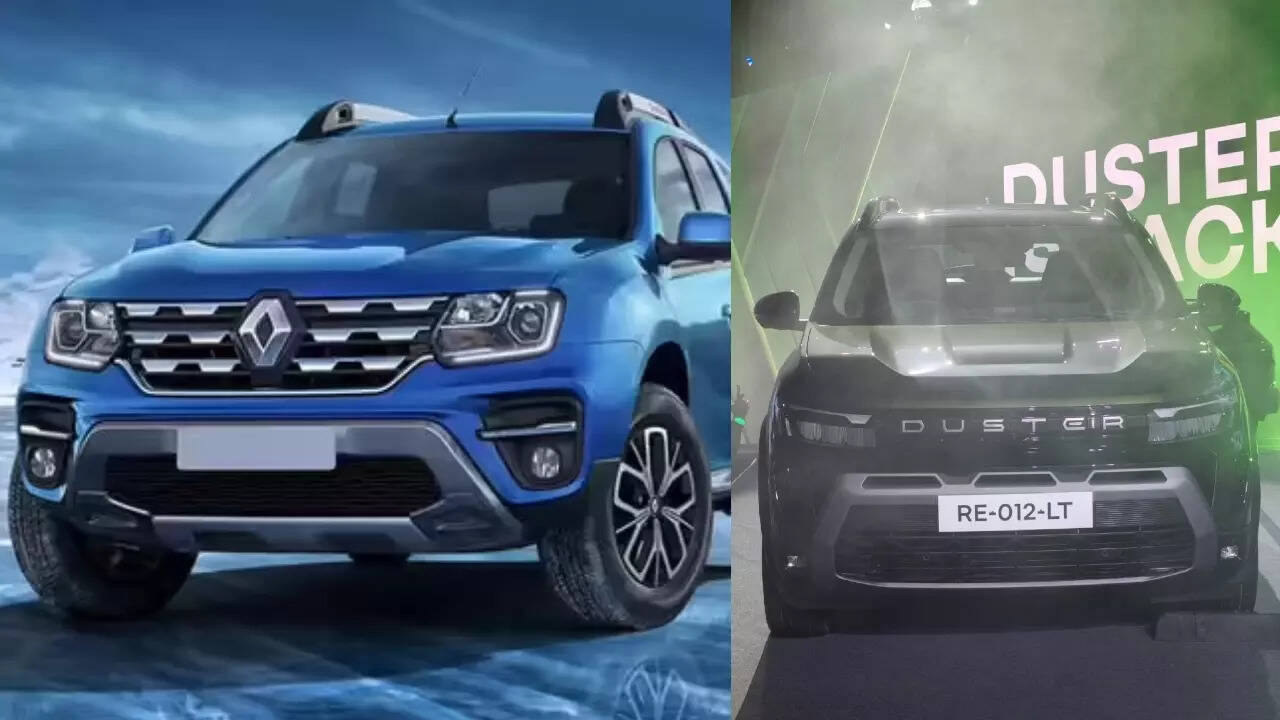
The transformation from the old Renault Duster to the 2026 model is nothing short of dramatic. While the previous-generation Duster featured a soft, rounded design, the new version embraces a much sharper, wider, and more muscular stance. Up front, the large grille of the older model has been replaced with a slimmer and more contemporary design, paired with sleek LED headlamps and distinctive Y-shaped DRLs. The bonnet now sits higher and flatter, with bold creases that add to the SUV’s rugged appeal. Overall, the new design makes the Duster look noticeably wider and more planted than before.
From the side, the familiar Duster silhouette remains, but it now appears more upright and angular. The new model gets thicker body cladding, squared-off wheel arches, and rear door handles that have been repositioned to the C-pillar. Roof rails are standard on both versions, but they are now fully functional on the new Duster. Wheel sizes have also increased, with the 2026 model offering 17-inch and 18-inch alloy wheels, compared to the 16-inch wheels on the outgoing Duster.
Exterior Design Comparison – Old Duster vs New Renault Duster 2026
At the rear, the old Duster had a clean and flat tailgate with simple tail-lamps. The new version features a more sculpted boot lid with a hunched profile. The Y-shaped lighting signature continues here as well, with LED tail-lamps that slightly protrude from the body. Other highlights include a roof-mounted spoiler, a prominent silver skid plate, and bold Duster badging on both the front fascia and the tailgate.
Engine and Powertrain Options – Petrol and Hybrid Comparison
Under the skin, the outgoing Duster was built on an older platform, whereas the 2026 Duster shifts to Renault Group’s newer and stiffer CMF-B architecture. The engine lineup has also been thoroughly updated. Towards the end of its lifecycle in India, the old Duster was offered with two petrol engines: a 1.5-litre unit producing 106 PS and a 1.3-litre turbo-petrol making 156 PS. In contrast, the new Duster comes with two turbo-petrol options. The Turbo TCe 160 delivers 163 PS and 280 Nm and is paired with a 6-speed wet-clutch DCT, while the Turbo TCe 100 produces 100 PS and 160 Nm and is offered with a 6-speed manual gearbox. Additionally, there’s a 1.8-litre strong hybrid system paired with a 1.4 kWh battery pack, capable of running in pure electric mode for up to 80 percent of city driving.
Inside the cabin, the old Duster was practical but clearly showed its age. Its interior focused on function over form, with a simple dashboard layout, a small integrated infotainment screen, and a basic instrument cluster.
The new Duster’s cabin, however, looks far more modern and premium. The dashboard is wider and more layered, with a strong horizontal theme that makes the interior feel broader and more SUV-like. The touchscreen infotainment system is larger, sharper, and now sits in a tablet-style layout at the centre. Below it, the air vents feature a cleaner and more technical design. The instrument cluster is now fully digital and more informative, displaying navigation, vehicle data, and driving modes.
The steering wheel has also been redesigned and now looks sportier and more premium, complete with a flat-bottom design. Overall cabin quality has improved with textured surfaces, contrast stitching, and layered trims on the dashboard and door panels. The centre console is better organized, offering improved storage and a more modern gear selector area. Renault also says the cabin is now more driver-focused, with a cockpit-style layout that keeps key controls within easy reach.
In terms of safety and features, the old Duster lacked advanced driver-assistance technology. The new model changes that with ADAS offering up to 17 India-specific features, along with a 360-degree camera. It also gains major comfort and convenience upgrades such as an electric tailgate, panoramic sunroof, dual-zone climate control, and powered front seats with ventilation.
Old vs New Renault Duster – Quick Comparison & What Changed
| Feature Area | Old Renault Duster | New Renault Duster (2026) |
|---|---|---|
| Design Language | Rounded, soft design | Sharper, wider, muscular stance |
| Front Grille & Lights | Large grille, simple headlamps | Slim grille, LED headlamps, Y-shaped DRLs |
| Bonnet | Lower, curved | Higher, flatter with strong creases |
| Side Profile | Classic silhouette, softer lines | Upright stance, squared wheel arches |
| Door Handles | Conventional placement | Rear handles moved to C-pillar |
| Roof Rails | Non-functional | Functional roof rails |
| Wheel Size | 16-inch alloys | 17-inch and 18-inch alloys |
| Rear Design | Flat tailgate, simple tail-lamps | Sculpted boot lid, Y-shaped LED tail-lamps |
| Badging | Subtle branding | Prominent Duster badging front & rear |
| Platform | Older-generation platform | Modern CMF-B architecture |
| Petrol Engines | 1.5L (106 PS), 1.3L Turbo (156 PS) | 1.0L Turbo (100 PS), 1.6L Turbo (163 PS) |
| Hybrid Option | Not available | 1.8L strong hybrid with 1.4 kWh battery |
| Transmission | Manual, CVT (market dependent) | 6-speed MT, 6-speed wet-clutch DCT |
| Interior Design | Simple, functional, dated | Modern, layered, wider dashboard |
| Infotainment | Small integrated screen | Large tablet-style touchscreen |
| Instrument Cluster | Analog/basic digital | Fully digital cluster |
| Steering Wheel | Basic design | Sporty, flat-bottom design |
| Cabin Quality | Basic materials | Textured surfaces, contrast stitching |
| Safety Tech | No ADAS | ADAS with up to 17 features |
| Camera System | Reverse camera | 360-degree camera |
| Comfort Features | Basic | Panoramic sunroof, ventilated seats, dual-zone climate |
| Tailgate | Manual | Electric tailgate |
New Renault Duster 2026 India Price
It is assumed that the starting price of the base variant is Rs.11.99 Lakhs, however, the exact prices will be announced in March 2026.
5 Cool Things You Need to Know About New Renault Duster 2026 India
Duster badging at the front instead of a Renault logo. That’s how important this car is to them. Three powertrains on offer a base 1 liter turbo paired to a manual or a 1.3 L turbocharged petrol engine with a six-speed DCT or a new 1.8 L hybrid that will come later in the year. Number three, the design. It looks smashing. a power tailgate, something a lot of SUVs in the segment miss, and a 700 liter boot, a super super seamless screen, and this gets Google integration, which means all you need to do is just put your credentials into your Google account and use this without the need to connect Android Auto or Apple CarPlay.
2026 Renault Duster – Feature Loaded With 3 Engine Options
Let’s start by popping open the bonnet of the new Renault Duster 2026 — and the first thing that stands out is the use of gas struts. This is a small but premium touch that makes lifting the hood feel effortless. You also get proper insulation under the bonnet, which helps reduce engine noise and adds to the overall refinement. It’s a detail you don’t always see in this segment, and it shows Renault is paying attention to quality.
The highlight in the engine lineup is the Turbo TCe 160 petrol motor. This is a 1.3-litre turbocharged engine that delivers a strong 160 horsepower and an impressive 280 Nm of torque. Power is sent to the wheels through a 6-speed wet-clutch dual-clutch automatic gearbox, which promises quick shifts and smoother performance, especially in city traffic and on highways.
For buyers looking for a more affordable and efficient option, Renault is also offering a 1.0-litre turbo-petrol engine, the same unit seen in the Renault Kiger. This engine produces 100 horsepower and 160 Nm of torque. It is paired exclusively with a 6-speed manual gearbox, making it a good choice for those who enjoy a more hands-on driving experience and want better fuel efficiency at a lower price point.
Now, the most interesting addition to the lineup is the strong hybrid powertrain. This version uses a 1.8-litre petrol engine paired with an 8-speed automatic gearbox. The combined output stands at 160 horsepower and 205 Nm of torque. What really sets this hybrid apart is its 1.4 kWh battery pack, which is almost double the size of what you get in rivals like the Maruti Grand Vitara.
Thanks to this larger battery, Renault claims something quite impressive — up to 80% of city driving can be handled purely on electric power. That means quieter drives, lower fuel consumption, and much better mileage in stop-and-go traffic. If these real-world figures hold true, the Duster hybrid could become one of the most fuel-efficient SUVs in its class.
Overall, whether you choose the punchy turbo-petrol, the budget-friendly 1.0-litre engine, or the tech-packed strong hybrid, the new Renault Duster 2026 clearly offers a wide range of powertrain options to suit different driving styles and budgets.
New Renault Duster 2026 India Launch, Booking Dates & Delivery Timelines
All right, let me quickly tell you about the launch and delivery timelines of the new Renault Duster. The deliveries of the turbo petrol engine models will begin in April 2026 and the deliveries of the hybrid engine options will begin in Diwali 2026. So that’s a long time from now. Also, pre-bookings for the Renault duster have began at 21,000 rupees. So if you want to pre-book your duster, well just reach out to Renoshuru and pre-book the duster.
